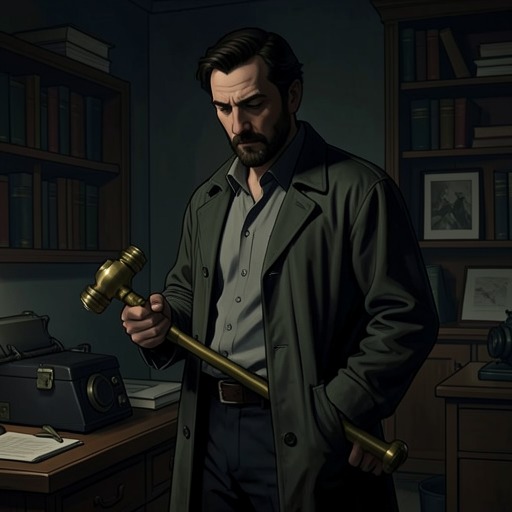
Roland Keefer
The Caine Mutiny Court-MartialRoland Keefer enters the novel in a tumble of books, jokes, and Southern speech, an outgoing sailor whose buoyant manner makes him memorable among Willie Keith’s roommates. His comic presence initially seems far removed from the disciplined courage of wartime service. The account of his death overturns that first impression: aboard the carrier Montauk, he takes charge amid catastrophic fires and continues directing the ship while gravely wounded. His brief appearance thus moves from conviviality to a reported act of extraordinary endurance.
Introduction and Shipboard Persona
Roland first appears when a heap of books enters the roommates’ quarters and collapses across a cot, revealing the tall, heavyset sailor carrying them. His flushed, cheerful face, crinkling eyes, and large, loose mouth establish an immediately vivid physical presence. He introduces himself with a musical Southern cadence and jokes about the burden of their studies. When Willie gives his own name and Ed Keggs adds his, the three men’s acquaintance begins in the informal intimacy of shared quarters.
Roland’s humor is not limited to that first encounter. At Club Tahiti, where Willie and May Wynn are trying to put a quarrel behind them, Roland arrives disheveled and bloodshot, towing a blonde companion. He greets Willie with easy familiarity, then becomes respectfully polite when introduced to May. A moment later, he resumes teasing Ed Keggs about attending a concert and turns the joke toward his companion. The quick shifts—from friendly greeting to courtesy and then irreverent banter—show his ease in company and his instinct for turning an evening into a performance.
That social energy is still present when his military orders arrive. On the eve of graduation, the midshipmen crowd into the corridor as orders are distributed. Roland notices that only two envelopes have reached a room shared by three men. When the messenger finds his own, he opens it, cheers, and dances: he has received staff duty in the Pacific. His excitement briefly gives way to concern when he notices Ed Keggs trembling beside his own envelope. In this small exchange, his celebration coexists with attention to a roommate’s distress; the exuberant figure is not indifferent to the people around him.
Family and the Keefer Brothers
Roland’s connection to Tom Keefer first surfaces through a letter from his father. Reading that Tom may be serving aboard the USS Caine, Roland asks Willie to help decipher the handwriting. The news surprises Willie, who is already assigned to that ship. Roland’s reaction is not based on close knowledge of Tom: he explains that they are half-brothers, share a father, and have seen little of each other. Their parents’ marriage ended early, and Tom’s mother took him to Boston, where she was from.
Roland describes Tom as a literary man who writes short stories and plays, has published work in magazines, and earns money from it. He recalls that Tom was a senior when he himself was a freshman at college, but says that Tom’s literary circle and candlelit poetry readings made them seem very different. Roland suspects that Tom considers him a moron and has not made much effort to know him. Yet his account is not simply hostile: he also calls Tom witty and says he is not a bad fellow. He predicts that Tom and Willie may get along because Willie reads Dickens. The prediction links Roland’s brotherly knowledge, however limited, to the friendship Willie will form aboard the USS Caine.
The letter also carries Tom’s sharply negative opinion of the USS Caine, which Roland relays to Willie while warning him not to take Tom too seriously. The ship’s poor reputation becomes a point of contact between the brothers, but it does not erase their distance: Roland must infer Tom’s life from their father’s handwriting and from what Tom has written home. The novel gives the reader Roland’s account of their separation before bringing the two men into the same wartime story through their ships and their shared friend.
Reunion, Combat, and Death
Later, while the USS Caine is working near Ulithi, Roland sends a blinker message from the carrier Montauk inviting Tom and Willie to visit. Tom and Willie search the crowded anchorage for him. When the ships pass close, they see Roland in a gun tub, waving a megaphone. He is leaner than Tom remembers, but his familiar good-humored grin remains. The brothers exchange shouted fragments across the water: Roland offers a wish of good luck, and Tom promises to hear about the war next time. The meeting is brief and noisy, a reunion conducted across the gap between two moving ships rather than in private conversation.
The expected next meeting does not bring Roland aboard. A boat from the Montauk approaches the USS Caine, and at first the officers mistake its approaching ensign for him. Tom recognizes that the young, bandaged visitor is not his brother. The ensign, Whitely, then tells Tom that Roland died of burns the previous day and was buried at sea. Tom’s face remains calm and apparently half-smiling as he asks Whitely to come below and explain what happened. He also identifies Willie as an old friend of Roland’s, placing Willie inside the family loss as well as the shipboard account that follows.
Whitely’s report makes Roland’s final actions concrete. Shells had started fires aft, the bridge and ordinary command arrangements had been disrupted, and aviation gasoline on the hangar deck made the emergency especially dangerous. As damage-control officer, Roland took over the firefighting effort. He had torpedoes and ammunition jettisoned, organized the fire parties, and brought the fires close to containment on the port side amidships. Then a suicide plane crashed into the bridge, setting off a further explosion and spreading fire across the flight deck. The ship listed, communications failed, and the Montauk circled at flank speed while confused sailors ran or jumped overboard.
Roland responded by connecting a gasoline generator to restore standby communications power and using the loudspeakers to direct firefighting. He ordered the magazines flooded and the sprinklers and carbon-dioxide systems activated. When the steering-engine room reported that it was receiving no steering orders, he took the conn as well, conning the ship over the loudspeaker and going out onto the catwalk to see ahead. A large piece of flaming wreckage fell on him and pinned him down. Sailors freed him, but although badly injured, he continued directing firefighting and steering while others supported him, treated his burns, bandaged him, and gave him morphine.
When Lieutenant Commander Volk, the senior surviving officer, took over the conn, Roland had managed to restore the crew to the familiar actions practiced in drills. He then passed out and was taken to sick bay; the following day he died of his burns. Whitely reports that Volk recommended him for the Navy Cross and expects he will receive it, but the account establishes the recommendation and expectation, not a confirmed award. Roland’s death is therefore presented through both the scale of the emergency and the specific work he performed within it.
Character and Narrative Significance
Roland’s characterization depends on the distance between his genial entrance and the disciplined competence revealed after his death. The book does not replace the cheerful, joking roommate with a wholly different man; rather, Whitely’s account shows that the same person who entertained his friends could take responsibility when command, communications, and the ship itself were in disorder. His jokes and social ease are the reader’s first access to him, while his actions on the Montauk make clear that they do not define the limits of his character.
His relationship with Tom gives this revelation a personal cost. The brothers have grown up apart, and Roland’s description of Tom mixes affection, frustration, and guesswork rather than the certainty of an intimate bond. Their shouted exchange at sea briefly offers the possibility of another meeting and a fuller account of their wartime lives. Whitely’s arrival closes that possibility before it can be realized. Through Willie’s friendship with Roland and his presence when the news is delivered, the death also connects the intimate circle of the USS Caine’s officers to the larger violence of carrier warfare. Roland remains a secondary figure, but his final story gives substance to a character first introduced as comic company: under fire, he becomes the officer who keeps the work going until another senior survivor can take command.